
Health & Structure Pruning
Tree Pruning in the Niagara Region, ON
Fewer, better cuts that leave your tree stronger, safer and better looking for years.
Pruning That Leaves Your Tree Stronger
A tree that's pruned well looks like nobody touched it. The crown is a little lighter, the dead branches are gone, nothing is rubbing and nothing hangs over the roof, but the shape is still the tree's own. That's the standard we prune to across the Niagara Region, whether it's a 60-year-old silver maple in Welland, a heritage oak in Niagara-on-the-Lake or a young linden planted by the builder in a new subdivision. Call (289) 672-1630 to book a free look at your trees.
Every pruning job starts with the question “what does this tree need?”, not “how much can we take off?”. Our arborist or crew lead walks the tree with you, points out the problems and explains what we'd cut and why. The quote lists it in plain words, so you know exactly what you're paying for.
What's Included
Crown Thinning
Selected branches removed from inside the crown so wind passes through instead of pushing against it like a sail. The tree keeps its outline and gets more light into its interior.
Crown Raising
Low limbs lifted to clear the roof, the driveway, the sidewalk or the lawn mower, taken back to the trunk or a strong side branch rather than stubbed.
Crown Reduction
A lighter, shorter crown made by cutting back to side branches big enough to take over. It's the proper alternative to topping when a tree has outgrown its space.
Deadwood Removal
Dead and dying branches taken out before they fall. In Niagara's big maples this is often the single most useful thing a homeowner can pay for.
Structural Pruning for Young Trees
Competing leaders reduced, tight forks corrected and the main branches spaced out while the tree is small. A few minutes of cutting now saves a big repair later.
Fruit and Ornamental Trees
Apple, pear, plum, peach and cherry trees pruned in the dormant season for light, airflow and fruit, along with flowering trees like magnolias, crabapples and redbuds.
Good Cuts and Bad Cuts
Where a cut is made matters more than how many cuts there are.
The branch collar. Where a branch joins the trunk there's a slightly swollen ring of tissue. A cut just outside it lets the tree grow callus over the wound and seal it off. A flush cut into the collar, or a stub left sticking out, does the opposite: it lets decay into the trunk.
The three-cut method. A heavy limb is never cut in one go. The crew makes a small undercut first, then takes the weight off further out, and only then makes the final cut at the collar. That stops the bark tearing down the trunk as the limb falls.
No topping. Topping means cutting a tree's main stems back to stubs to make it shorter. It starves the tree, invites decay into every stub and triggers a flush of fast, weakly attached sprouts. Within a few years the tree is taller, thicker and more dangerous than before. If a tree is truly too big for its spot, we'll talk you through reduction or, if it comes to that, removal.
Not too much at once. A healthy mature tree shouldn't lose more than about a quarter of its live crown in a season, and older or stressed trees much less. Our quotes are written to that limit.
What Does Tree Pruning Cost?
Pruning is priced by the tree, not by a chart. The same 15-metre maple can be a two-hour deadwood job or a full day of thinning, depending on what it needs and how the crew can get to it. That's why we price pruning only after we've seen the tree.
| Tree | Typical price |
|---|---|
| Small tree (under about 6 m) | Quoted on site |
| Medium tree (6–15 m) | Quoted on site |
| Large mature tree (over 15 m) | Quoted on site |
| Fruit tree (dormant pruning) | Quoted on site |
What drives the price: the tree's size, how much work it needs, whether it's over a roof or wires, access for the crew and equipment, and whether you want the wood chipped, hauled or left cut to length. Several trees on one visit usually cost less per tree.
How It Works
- 1
Look at the Tree
Our arborist or crew lead walks the tree with you, checks its health and structure, and notes nests, wires and anything nearby that needs protecting.
- 2
Written Quote
A plain list of what we'll cut, what we won't, how the wood is handled and the price.
- 3
Check the Rules
We confirm whether your town or the Region has anything to say about the tree. For pruning, the answer is almost always no.
- 4
Prune
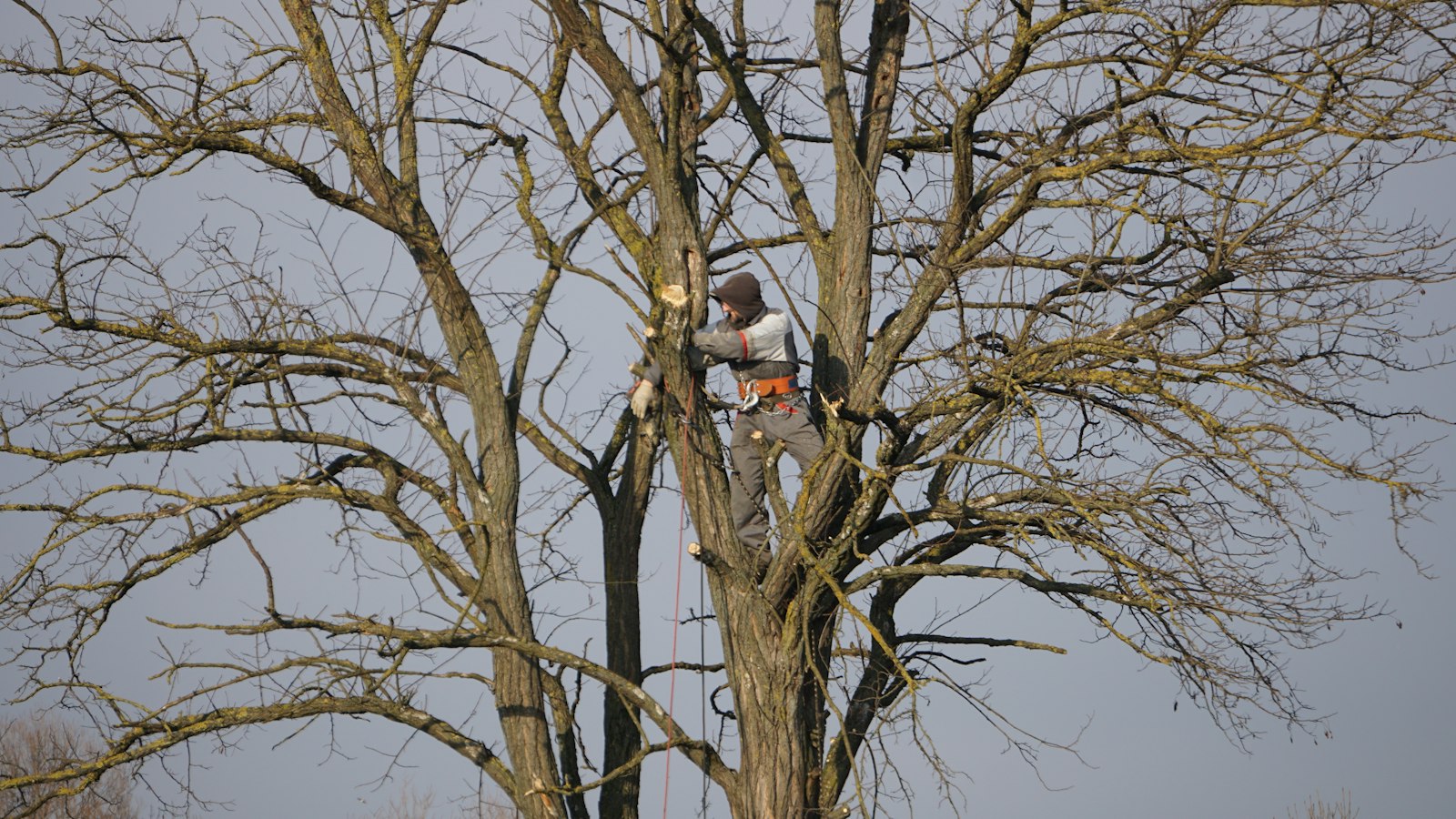
The climbing crew makes the cuts while the ground crew lowers wood on ropes where it can't simply drop.
- 5
Clean Up
Branches chipped, wood dealt with the way you asked, and the lawn, beds and driveway cleared before we leave.
Tree Pruning Questions
What's the right time of year to prune trees in Niagara?
Late winter, while the tree is dormant, suits most species and is the only time oaks should be pruned, because oak wilt is now in Niagara. Deadwood and safety pruning can be done any time of year.
How much should be cut off?
As little as gets the job done. A healthy mature tree can usually lose up to about a quarter of its live crown in one season, but many trees need far less. We'll show you what we plan to take before we start.
Do you prune fruit trees?
Yes. Apple, pear, cherry, plum and peach trees are pruned in the dormant season to open the centre, remove crossing wood and keep the tree a size you can pick from.
Main Towns We Serve
More Places Across Niagara
- Tree service in Thorold
- Tree service in Port Dalhousie
- Tree service in Merritton
- Tree service in Virgil
- Tree service in St. Davids
- Tree service in Queenston
- Tree service in Beamsville
- Tree service in Vineland
- Tree service in Jordan
- Tree service in Fonthill
- Tree service in Fenwick
- Tree service in Wellandport
- Tree service in Port Colborne
- Tree service in Wainfleet
- Tree service in Fort Erie
- Tree service in Ridgeway
- Tree service in Crystal Beach
- Tree service in Port Robinson
- Tree service in Chippawa
- Tree service in Stamford
- Tree service in Allanburg
Ready for a Better-Pruned Tree?
Tell us about the tree and we'll come and look. You'll know exactly what we plan to cut before we start.